mrkr vs Amplitude.
Amplitude is built for an analytics practice with a data team behind it. mrkr is built for the team that wants funnels, conversion journeys, and replay working by lunchtime.
In short
What is the difference between mrkr and Amplitude?
Amplitude is enterprise product analytics: deep behavioural cohorting, governed event taxonomies, and analysis across very large event volumes. mrkr is privacy-first web analytics with funnels, journeys, and session replay that work from a single script tag. Amplitude is cookie-based. mrkr is cookieless by default.
Amplitude answers questions a product organisation asks over quarters. mrkr answers questions a small team asks on a Tuesday: which channel brought this signup, where did the funnel leak, what did that session look like. Different questions, and the tools follow from them.
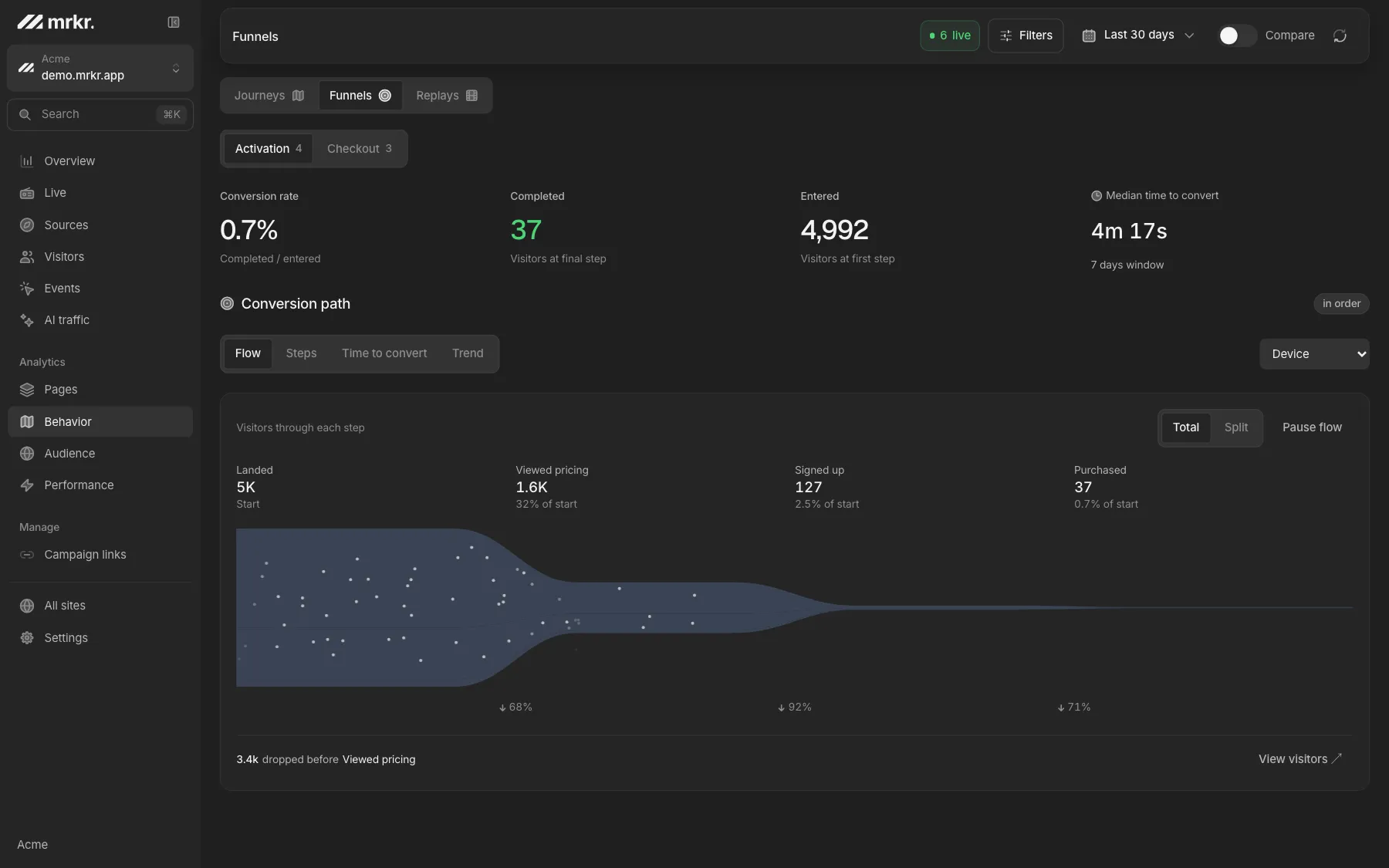
Conversion on the first day.
mrkr evaluates funnels from captured paths and events, then shows where visits drop off. Inspect sources and visitor journeys to understand the sessions behind those outcomes.
Where mrkr is better.
Useful before instrumenting
Amplitude with no events is an empty workspace. mrkr is already a full dashboard.
No banner by default
Amplitude sets a persistent identifier. mrkr counts people without storing anything.
Acquisition is built in
Referrers, campaigns, AI assistants, and bots, uninstrumented. Amplitude knows only what you send.
Replay in the same dataset
Recordings carry their source and revenue, so you can watch a campaign that did not convert.
Compared
Side by side.
| Feature | mrkr | Amplitude |
|---|---|---|
| Category | Privacy analytics with replay | Product analytics |
| Session replay | On every paid plan | Yes |
| Heatmaps | No | No |
| Funnels | Yes | Yes |
| Saved cohorts | No | Yes |
| Revenue attribution | Yes | Yes |
| Cookieless | By default (optional cookie mode) | No |
| Free plan | No, $1 for 14 days | An event-capped free tier |
| Entry paid price | $5/mo, 100K pageviews, session replay included | Event-volume pricing, A free tier, then paid tiers by monthly event volume |
| Behavioural cohorts from event sequences | No | Yes |
| Acquisition cohorts and retention curves | No | Yes |
| Traffic sources and campaigns without instrumentation | Yes | No |
| Core Web Vitals | Yes | No |
| Consent banner in the EU | Not in the default cookieless mode | Yes |
| Time to a populated dashboard | One script tag, minutes | After the taxonomy is instrumented |
Amplitude details checked against the vendor's own pricing and feature pages on 2026-08-24. Where a vendor does not publish a fixed list price, this table says how they charge rather than guessing a number. Vendors change packaging often, so confirm before you buy.
Live demo
Judge it on real data. Funnels, journeys, and replay all run on the live demo dataset. If the depth is not enough for your question, you will know in two minutes.
Open the live demoWhere Amplitude is genuinely better.
Behavioural cohorting
Everyone who did A then B but not C, tracked forever. mrkr has nothing approaching it.
Analysis depth
Pathfinding and statistical tooling for analysts. mrkr focuses on traffic, funnels, journeys and revenue.
Governance at scale
Taxonomy enforcement and event approval across a large org. mrkr has workspaces and roles.
Cross-platform identity
One user across web, iOS, and Android. mrkr is web only and does not follow across days.
FAQ
Is mrkr an Amplitude replacement?
For a marketing site or a small product, yes. For an enterprise analytics practice with behavioural cohorts, governance, and a data team maintaining the taxonomy, no. Amplitude is built for that and mrkr does not compete there.
What does Amplitude need that mrkr does not?
An event taxonomy and someone to maintain it. Amplitude is only as good as the events you send it. mrkr autocaptures pageviews, navigations, sources, campaigns, and Core Web Vitals from the script tag, so it is useful before any custom event exists.
Does Amplitude require consent in the EU?
It identifies users with a persistent device identifier, so in practice yes, you ask for consent before it runs. mrkr in its default cookieless mode sets no cookie and writes nothing persistent to the visitor device, so it needs no banner. Cookie mode is an optional per-site setting that changes this.
Does mrkr have behavioural cohorts?
No. mrkr provides traffic filters, funnels and individual visitor journeys. It does not provide saved cohorts or signup-week retention curves.
Which is cheaper?
They meter different things, so compare on your own numbers. Amplitude has a free tier and then prices by monthly event volume with negotiated tiers above that. mrkr bills on pageviews only: custom events, goals, revenue events, autocapture, and session replay do not count against the quota, and overage is a flat rate per thousand pageviews.
Can I run Amplitude and mrkr together?
Yes, and some teams should. Amplitude for the logged-in product, mrkr for the marketing site and the acquisition side. Both scripts load asynchronously and neither interferes with the other.
Start with one line of HTML.Your first visitors show up within a minute.