Tag the link, then follow it to the money.
mrkr reads UTM parameters on arrival and attaches them to the session, so the campaign is still attached when the visitor reaches your funnel, your goals, and your revenue.
In short
What is UTM tracking?
UTM tracking means adding labelled parameters to a link so your analytics knows where the click came from. The five parameters, utm_source, utm_medium, utm_campaign, utm_term and utm_content, travel in the URL, get read when the page loads, and are stored against that visit. Nothing is installed and no cookie is needed.
They exist because a referrer alone is not enough. Two clicks can both arrive from the same social network and mean completely different things: one from a paid placement, one from someone quoting you. The tag is how you tell them apart.
If you only need the link itself, the free UTM builder composes one in the browser with no account and nothing installed. The rest of this page is about what happens after somebody clicks it.
Compared
The five parameters, and which ones mrkr reports. An honest table rather than a generic one. Three of the five are first-class dimensions in mrkr; the other two are accepted but not reported separately.
| Parameter | What it holds | Example | Reported in mrkr |
|---|---|---|---|
| utm_source | The specific platform or publication | newsletter, reddit, producthunt | Its own dimension |
| utm_medium | The channel type | email, cpc, social, affiliate | Its own dimension |
| utm_campaign | The named initiative | spring-launch, q3-webinar | Its own dimension |
| utm_term | Paid keyword | privacy analytics | Accepted, not reported |
| utm_content | Which creative or link variant | hero-cta, footer-link | Accepted, not reported |
If per-creative reporting matters to you, fold the variant into the campaign value, for example spring-launch-hero. It is less elegant and it actually shows up in the report.
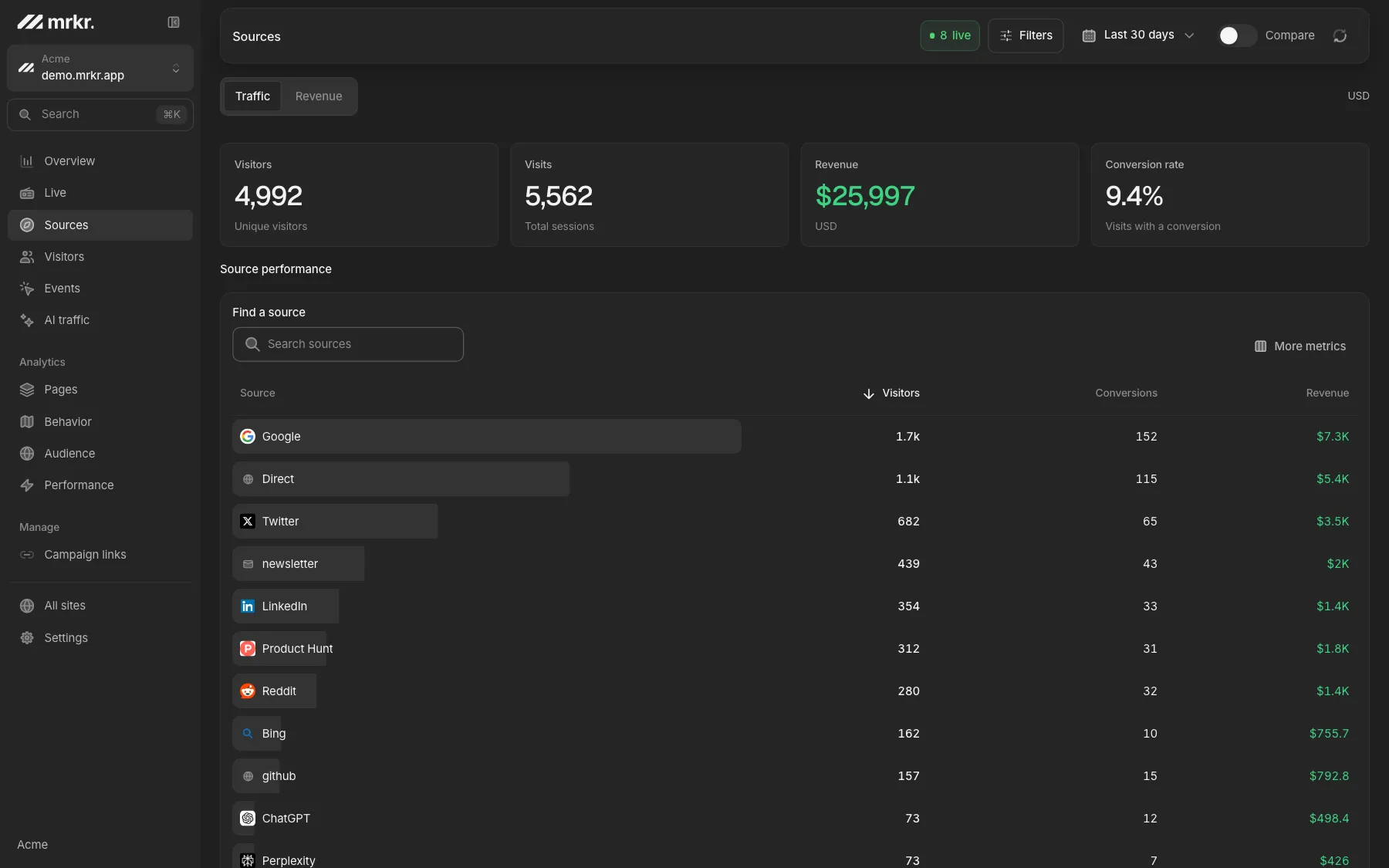
Tagged visits land in sources, automatically.
There is no configuration step. The tracker reads the parameters from the landing URL, ingest classifies them alongside the referrer, and the visit is filed under its campaign from that moment on.
Campaign acquisition is counted in visits rather than visitors, because a campaign click is a visit: one visit owns exactly one campaign, so the numbers sum cleanly against your session total instead of double-counting someone who arrived twice on two different links.
Naming rules that save you later.
Lowercase, always
UTM values are case sensitive and normalised nowhere in the chain. Newsletter and newsletter are two rows, forever.
One separator, chosen once
Hyphens or underscores, not both. Mixed separators are the commonest way a campaign report becomes unreadable.
Source is the place, medium is the type
reddit plus social, mailchimp plus email, google plus cpc. Putting the platform in both fields kills the medium breakdown.
Write campaigns for your future self
q3 means nothing in April. Name it after what it was: pricing-page-relaunch, black-friday-2026.
How it works
From a link to an answer.
- 1
Build the link
Compose it in the campaign links builder inside mrkr, or use the free UTM builder. Saved links keep their label so you can find them again months later.
- 2
Ship it
Newsletter, ad, social post, affiliate, QR code, conference slide. The parameters ride in the URL, so nothing needs to be installed at the other end.
- 3
mrkr attaches it to the session
Source, medium and campaign are stored on the session, next to the classified referrer, device, country and entry page.
- 4
Filter everything by it
Every view takes the same filters, so you can put a funnel, a revenue total, a page-performance table or a set of session recordings behind one campaign.
Live demo
See campaigns on real data. The live demo has a populated campaigns view with sources, mediums and named campaigns. No signup, no card.
Open the live demoWhat tagging cannot fix.
A UTM records a click, not a customer
Someone who reads your newsletter and searches your name a week later is recorded as organic. That is what last-click means.
Windows longer than a day need cookie mode
The identifier rotates daily, so a campaign cannot be credited for a purchase the next day. Cookie mode needs consent.
Tagged links multiply your URLs
One page reached through five campaigns is five URLs to a crawler. Point a canonical tag at the clean version.
FAQ
Does tagging more campaigns cost more?
No. mrkr bills on pageviews and nothing else. UTM parameters ride in on the pageview that was already counted, so a hundred tagged links cost exactly what one does, and the campaign, goal and revenue events behind them are free.
What are UTM parameters?
Five optional query parameters you append to a link so analytics can tell where a click came from: utm_source, utm_medium, utm_campaign, utm_term and utm_content. They are read by the analytics tool when the page loads and attached to that visit's session.
How does UTM tracking work in mrkr?
The tracker reads utm_source, utm_medium and utm_campaign from the landing URL and sends them with the pageview. Ingest attaches them to the session, so every downstream report, sources, campaigns, funnels and revenue, can be split by them. No configuration is required.
Does mrkr support utm_term and utm_content?
They are accepted and can be saved on a campaign link, but they are not reported as their own dimensions. mrkr reports and filters on utm_source, utm_medium and utm_campaign. If you need per-ad or per-keyword reporting, encode it into the campaign value instead.
Do UTM parameters need cookies?
No. The parameters are in the URL of the landing request, so they are read once, on arrival, and stored with the session. That works in mrkr's default cookieless mode with no consent banner required for it.
What is the right way to name UTMs?
Lowercase everything, pick one separator and never mix them, keep source to the platform and medium to the channel type, and write the campaign so it still means something in six months. UTM values are case sensitive and are not normalised, so Newsletter and newsletter become two separate rows forever.
Are UTM parameters bad for SEO?
They create additional URLs for the same content, which is worth handling with a canonical tag pointing at the clean URL. In practice tagged links are shared and pasted, so a canonical is the safe default rather than an optional extra.
Start with one line of HTML.Your first visitors show up within a minute.